


Priority Postage: what it is and how it can help your business
Some of you have been asking, and rightly so.
Back in February, Royal Mail increased the price of 1st Class post.
Since then, a few customers have asked us:
“Why has 1st Class gone up so much? And why haven’t franking prices changed too?”
Good questions. The honest answer is that it is complicated, but we have explained it below.
Luckily, Priority Postage is here to simplify things.
So, let’s walk through what is happening and how Priority Postage could help your business send important post quickly while keeping postage costs under control.
What is Priority Postage?
Priority Postage is an option from Royal Mail that gives businesses quick delivery, typically within 2 working days, at a lower price than traditional 1st Class post.
In simple terms, your post still arrives quickly, but you do not have to pay the full 1st Class rate.
For businesses sending lots of important post, that price difference can add up to significant savings without having to compromise on speed.
It can be particularly useful for regular business mail that needs to reach recipients promptly but does not need to travel using the full-price 1st Class service.
Why did Royal Mail launch Priority Postage?
The answer lies in how Royal Mail is regulated.
For 1st and 2nd Class post, Royal Mail is required to meet strict delivery targets, known as Service Level Agreements or SLAs.
If those targets are missed, Royal Mail can face financial penalties. With large volumes moving through these regulated services, consistently meeting those targets has become more difficult.
You may have seen headlines at the time about Royal Mail being fined for missing some of its regulated SLAs.
That is where Priority Postage comes in.
Priority Postage sits outside these regulated services, so Royal Mail is not held to the same strict delivery targets, even though delivery still typically happens within 2 working days.
By encouraging businesses to use Priority instead of 1st Class, Royal Mail can reduce pressure on its regulated services, ask downstream access providers to complete part of the work, continue delivering post quickly and reduce some of the compliance and penalty risks attached to 1st and 2nd Class post.
Priority Postage vs 1st Class and 2nd Class
Business postage options can get confusing quickly, especially when prices, delivery times and regulated services all work differently.
The comparison table below shows how Priority Postage compares with 1st Class and 2nd Class business post.
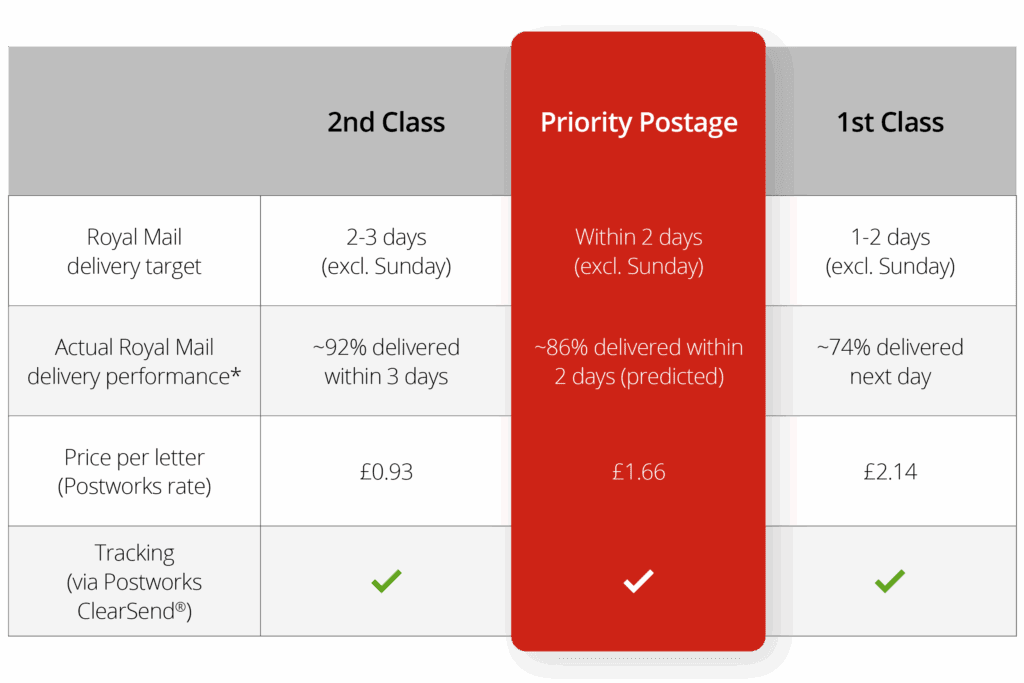
*Ofcom 2024/2025 data.
The main difference is that Priority Postage gives businesses a middle option. It is designed for post that needs to arrive quickly, but where paying the full 1st Class rate may not be necessary.
Who is Priority Postage useful for?
If you are sending important business post that needs to arrive quickly, but you would also like to reduce postage costs, Priority Postage could be a good fit.
Insolvency and legal firms
When sending statutory notices, creditor letters, appointment paperwork or other time-sensitive legal documents, firms still need post to arrive quickly but may not always need the full-price 1st Class service.
Local government
Councils and government departments sending council tax bills, reminders, benefit letters, legal notices and other outbound correspondence can maintain delivery speed while reducing costs across large mail volumes.
Parking and enforcement
Notice to Keepers, PCNs, appeal responses and payment demands often need timely delivery. Priority Postage offers a more cost-effective alternative for high-volume enforcement mailings.
Debt recovery and financial services
Collection notices, payment reminders, account statements and financial correspondence can still reach recipients quickly while helping businesses manage growing postage costs.
General business post
Priority Postage can also work well for invoices, statements, customer communications and operational letters that do not require legal-grade tracking but still need to reach people quickly and reliably.
Why haven’t franking prices changed in the same way?
This is where things get a little technical.
When Royal Mail adjusted its 1st Class pricing earlier in the year, the change mainly affected account-based pricing, which is the pricing structure used by providers such as Postworks.
Franking sits under a separate tariff structure that is still part of the regulated services.
That meant business account rates moved while franking tariffs remained mostly unchanged.
Although both options are used to send business mail, the prices do not always move at the same time because they sit within different tariff structures.
Switching to Priority Postage is easy
If Priority Postage sounds like a good fit for your business, you do not need to change anything complicated to get started.
It will be available in your Postworks account from 8 August.
There is no setup required. Simply select Priority when uploading your post, and that is it.
If you are unsure which postage option is right for your business, or you would like to talk through how Priority Postage could help reduce your mailing costs, our Product Specialists are here to help.